Greenhouse Gases and Energy
▍GHG Emissions Management
In terms of GHG inventory and assurance planning, the Company completed standalone GHG inventories for the parent company in 2024 and 2025; however, third-party assurance (verification) has not yet been conducted. To continuously improve the GHG management mechanism, we plan to expand inventory coverage to subsidiaries included in the consolidated financial statements starting in 2026 and plan the assurance (verification) timelines simultaneously. Specifically, it is expected that third-party assurance (verification) for the parent company's 2027 inventory will be completed in 2028, while consolidated subsidiaries are scheduled for assurance in 2029. The Company will evaluate engaging qualified third-party assurance bodies to enhance disclosure credibility and transparency.
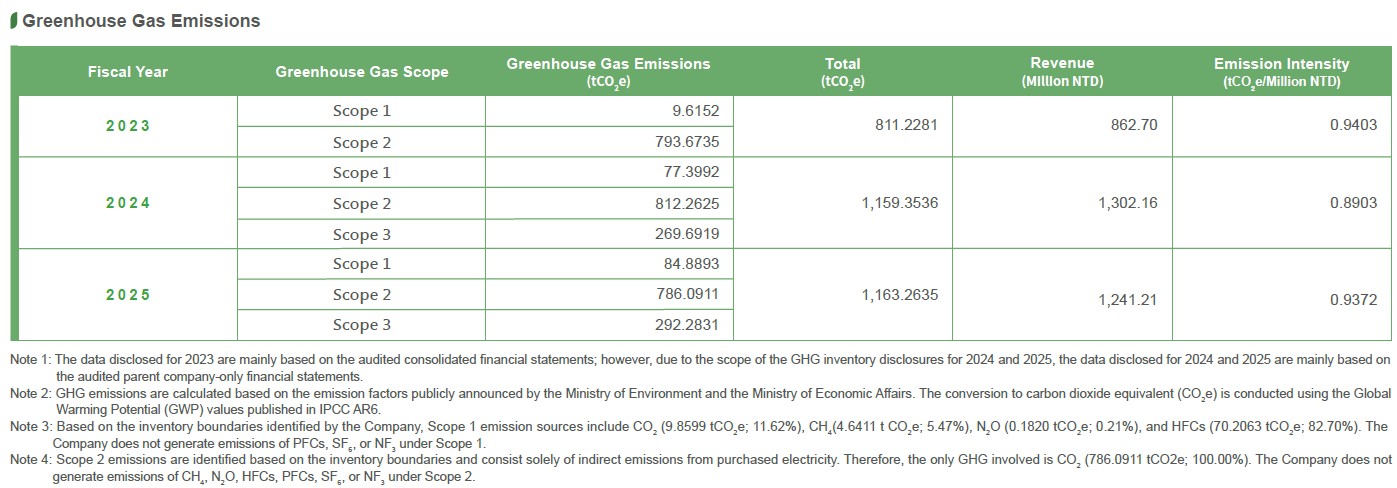
Regarding overall emission performance, Brogent's GHG emissions data from 2023 to 2025 covered the Kaohsiung headquarters, Manufacturing Center (Taoyuan Plant), and Taipei office in Taiwan; According to the Greenhouse Gas Emissions table, total GHG emissions in 2025 amounted to 1,163.2635 tCO₂e, representing an increase of 3.9099 tCO₂e (approximately 0.34%) compared to the previous fiscal year. Emissions intensity was 0.9372 tCO₂e per NT$ million in revenue.
Upon analysis, due to operational requirements, new air-conditioning equipment was installed and certain units were replaced, resulting in an increase of 7.4901 tCO₂e (approximately 9.68%) in Scope 1 GHG emissions compared to the previous fiscal year. In addition, to expand the boundaries of the inventory and improve the transparency of information, in addition to previously inventoried Scope 3 emission sources, the Company expanded Scope 3 emission sources in 2025 and included new emission categories, resulting in an overall increase of 22.5912 tCO₂e within Scope 3. However, benefiting from equipment upgrades, the Company's electricity consumption in a single quarter was reduced by approximately 8.4%, leading to a reduction of 26.1714 tCO₂e (approximately 3.2%) in Scope 2 GHG emissions.
Overall, with the gradual introduction of energy-saving equipment and increased electricity efficiency, despite the inclusion of more indirect emission sources, GHG emissions this fiscal year showed only slight growth, indicating that the Company has achieved a sound balance between operational development and emission management, laying the foundation for subsequent Scope 3 reduction strategies.
In addition to promoting equipment energy conservation improvements, the Company continues to strengthen its GHG management mechanisms by gradually integrating sustainable product mindset into product R&D and design stages. The Company also enhances employees' understanding of climate change risks and management awareness through internal advocacy and training. Moreover, the Company expands Scope 3 GHG inventory coverage in accordance with ISO 14064-1 principles, gradually adding new inventory categories and improving data completeness to reinforce the overall emissions management foundation.
▍GHG Reduction Measures
With 2024 as the base year for GHG reduction, Brogent's Scope 1 and Scope 2 GHG emissions this fiscal year amounted to 870.9804 tCO2e. The Company has established a mid- to long-term target to achieve a 20% reduction in Scope 1 and Scope 2 emissions by 2030. To achieve the aforementioned reduction target, the Company has planned and implemented the following carbon reduction initiatives:


In terms of specific carbon reduction measures, we implemented the replacement of high-energy-consuming air-conditioning equipment at the Kaohsiung headquarters this fiscal year and invested NT$10,320 thousand in the purchase of water-cooled inverter air-conditioning system. The energy-saving rate after the improvement reached 41.22%, which complied with the 2025 Energy Efficiency Performance Guarantee Program of the Ministry of Economic Affairs. Relevant government subsidies were obtained. Benefiting from the equipment upgrade, the Company achieved an approximate 8.4% reduction in total electricity consumption within a single quarter, resulting in a 3.2% decrease in overall Scope 2 GHG emissions. Overall, although short-term emissions fluctuations may occur due to equipment replacement and operational adjustments, continuous operation of the upgraded systems over a full fiscal year is expected to further enhance energy-saving and carbon reduction performance. 2. Professional Competency Training Results
In 2025, the Company continued to strengthen professional competencies in GHG management and sustainable development through external training programs. Relevant employees have completed and obtained the ISO 14064-1:2018 GHG Inventory Lead Verifier Training, ISO 14067-1:2018 Product Carbon Footprint Lead Verifier Training, Ministry of Economic Affairs iPAS Net-Zero Carbon Planning Manager Certification (Elementary/Intermediate Level), and Financial Supervisory Commission (FSC) Sustainable Development Fundamental Capacity Certification. Through systematic training and professional certifications, the Company continues to enhance its expertise in GHG inventory management, carbon management, and sustainability practices, strengthening the foundation for advancing carbon reduction strategies.
In 2025, the Company conducted internal sustainability-related training and general awareness programs, with a total of approximately 400 participant attendances and a total of 522.5 hours of training. These programs were designed to enhance employees' overall awareness and engagement in sustainability issues, including climate change, GHG management, energy conservation, and carbon reduction.
▍Non-Renewable Energy Management
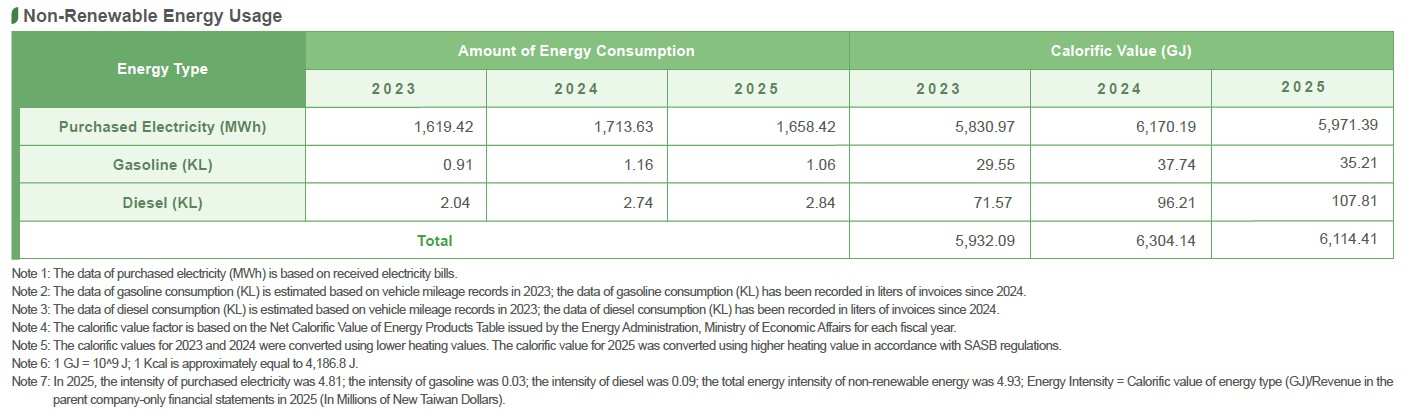
Brogent's non-renewable energy data from 2023 to 2025 includes the Kaohsiung headquarters, Manufacturing Center (Taoyuan Plant) and Taipei office in Taiwan; in 2025, the purchased electricity was 1,658.42 MWh, gasoline was 1.06 KL, and diesel was 2.84 KL. After the three types of energy were converted to calorific value, the total was 6,114.41 GJ.
With 2024 as the base year for GHG emissions reduction and in line with the spirit of ISO 14064-1:2018 and GHG Protocol, Brogent adopts the operational control approach to define organizational boundaries and conducts GHG inventory and management activities accordingly. Brogent has set the mid- to long-term target of reducing Scope 1 and Scope 2 emissions by 20% by 2030 as a guiding direction for continuously improving energy efficiency and promoting carbon reduction actions. To strengthen internal governance and execution, Brogent officially established a Greenhouse Gas Inventory Team in 2025, responsible for the establishment and implementation of GHG management systems, planning inventory-related matters, tracking emission data, and reviewing emission reduction measures. Through systematic management and periodic self-assessment mechanisms, the Company aims to progressively enhance its GHG management maturity.
In terms of GHG inventory and assurance planning, the Company completed standalone GHG inventories for the parent company in 2024 and 2025; however, third-party assurance (verification) has not yet been conducted. To continuously improve the GHG management mechanism, we plan to expand inventory coverage to subsidiaries included in the consolidated financial statements starting in 2026 and plan the assurance (verification) timelines simultaneously. Specifically, it is expected that third-party assurance (verification) for the parent company's 2027 inventory will be completed in 2028, while consolidated subsidiaries are scheduled for assurance in 2029. The Company will evaluate engaging qualified third-party assurance bodies to enhance disclosure credibility and transparency.
Regarding overall emission performance, Brogent's GHG emissions data from 2023 to 2025 covered the Kaohsiung headquarters, Manufacturing Center (Taoyuan Plant), and Taipei office in Taiwan; According to the Greenhouse Gas Emissions table, total GHG emissions in 2025 amounted to 1,163.2635 tCO₂e, representing an increase of 3.9099 tCO₂e (approximately 0.34%) compared to the previous fiscal year. Emissions intensity was 0.9372 tCO₂e per NT$ million in revenue.
Upon analysis, due to operational requirements, new air-conditioning equipment was installed and certain units were replaced, resulting in an increase of 7.4901 tCO₂e (approximately 9.68%) in Scope 1 GHG emissions compared to the previous fiscal year. In addition, to expand the boundaries of the inventory and improve the transparency of information, in addition to previously inventoried Scope 3 emission sources, the Company expanded Scope 3 emission sources in 2025 and included new emission categories, resulting in an overall increase of 22.5912 tCO₂e within Scope 3. However, benefiting from equipment upgrades, the Company's electricity consumption in a single quarter was reduced by approximately 8.4%, leading to a reduction of 26.1714 tCO₂e (approximately 3.2%) in Scope 2 GHG emissions.
Overall, with the gradual introduction of energy-saving equipment and increased electricity efficiency, despite the inclusion of more indirect emission sources, GHG emissions this fiscal year showed only slight growth, indicating that the Company has achieved a sound balance between operational development and emission management, laying the foundation for subsequent Scope 3 reduction strategies.
In addition to promoting equipment energy conservation improvements, the Company continues to strengthen its GHG management mechanisms by gradually integrating sustainable product mindset into product R&D and design stages. The Company also enhances employees' understanding of climate change risks and management awareness through internal advocacy and training. Moreover, the Company expands Scope 3 GHG inventory coverage in accordance with ISO 14064-1 principles, gradually adding new inventory categories and improving data completeness to reinforce the overall emissions management foundation.
▍GHG Reduction Measures
With 2024 as the base year for GHG reduction, Brogent's Scope 1 and Scope 2 GHG emissions this fiscal year amounted to 870.9804 tCO2e. The Company has established a mid- to long-term target to achieve a 20% reduction in Scope 1 and Scope 2 emissions by 2030. To achieve the aforementioned reduction target, the Company has planned and implemented the following carbon reduction initiatives:
▍GHG Management Performance
1. GHG Emissions Management ResultsIn terms of specific carbon reduction measures, we implemented the replacement of high-energy-consuming air-conditioning equipment at the Kaohsiung headquarters this fiscal year and invested NT$10,320 thousand in the purchase of water-cooled inverter air-conditioning system. The energy-saving rate after the improvement reached 41.22%, which complied with the 2025 Energy Efficiency Performance Guarantee Program of the Ministry of Economic Affairs. Relevant government subsidies were obtained. Benefiting from the equipment upgrade, the Company achieved an approximate 8.4% reduction in total electricity consumption within a single quarter, resulting in a 3.2% decrease in overall Scope 2 GHG emissions. Overall, although short-term emissions fluctuations may occur due to equipment replacement and operational adjustments, continuous operation of the upgraded systems over a full fiscal year is expected to further enhance energy-saving and carbon reduction performance.
In 2025, the Company continued to strengthen professional competencies in GHG management and sustainable development through external training programs. Relevant employees have completed and obtained the ISO 14064-1:2018 GHG Inventory Lead Verifier Training, ISO 14067-1:2018 Product Carbon Footprint Lead Verifier Training, Ministry of Economic Affairs iPAS Net-Zero Carbon Planning Manager Certification (Elementary/Intermediate Level), and Financial Supervisory Commission (FSC) Sustainable Development Fundamental Capacity Certification. Through systematic training and professional certifications, the Company continues to enhance its expertise in GHG inventory management, carbon management, and sustainability practices, strengthening the foundation for advancing carbon reduction strategies.
In 2025, the Company conducted internal sustainability-related training and general awareness programs, with a total of approximately 400 participant attendances and a total of 522.5 hours of training. These programs were designed to enhance employees' overall awareness and engagement in sustainability issues, including climate change, GHG management, energy conservation, and carbon reduction.
▍Non-Renewable Energy Management
Brogent's non-renewable energy data from 2023 to 2025 includes the Kaohsiung headquarters, Manufacturing Center (Taoyuan Plant) and Taipei office in Taiwan; in 2025, the purchased electricity was 1,658.42 MWh, gasoline was 1.06 KL, and diesel was 2.84 KL. After the three types of energy were converted to calorific value, the total was 6,114.41 GJ.
▍Renewable Energy Management
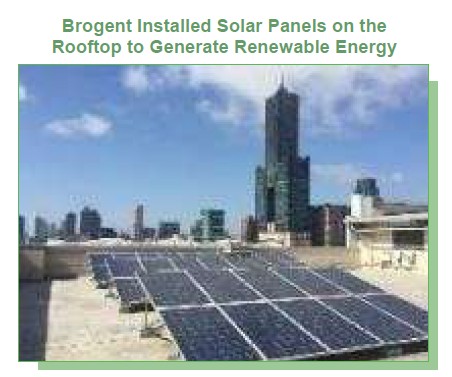
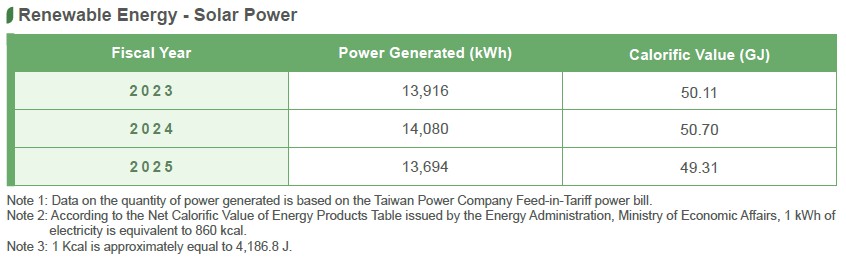
Brogent supports the government's green energy policy. In 2016, Brogent installed a renewable energy power generation equipment "solar power generation system" at its Kaohsiung headquarters in Taiwan, which has a capacity of 9.8kW, and the generated renewable energy electricity was sold to Taiwan Power Company. The electricity generation was 13,694 kWh in 2025, which was equivalent to 49.31 GJ.